Family Technology Exhibitions
Saturday 25th and Sunday 26th October 2014
University of Salford, MediaCity UK, Salford. M50 2HE
Telecommunications, Computing and Television
Telecommunications Exhibition
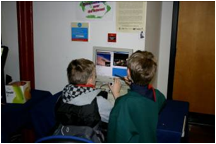
See how technology has changed the way we communicate from using semaphore flags to today’s 4G smart phones. Try your hand at sending messages using Morse Code, find out how the telephone works, learn how broadband is delivered to your home, marvel at how big mobile phones used to be and discover how radio allows you to communicate around the globe. This exhibition contains a range of hands-on activities that will engage the whole family.
Television Showcase
Come and see the latest developments in television. You will be able to visit the University’s state of the art special effects studios to find out how computers control what we see, watch the latest in super high definition television, learn more about how television pictures are delivered to your home, smart phone and tablets and see how television technology has evolved from the early days of analogue broadcasting to today’s world of digital media.
Retro Computing
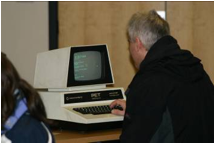
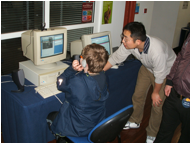
Come and relive some of the early days of the home computer. Our retro computing display will take you back to the 1980s where you will be able to use classic machines produced by companies such as Sinclair, Commodore, Acorn and Apple, all in working condition and all running software and games from the period. Try our retro gaming challenge and see who can gain the highest score in a fixed time. Then contrast these early machines with new developments in home computing using devices such as the raspberry pi.
FREE ENTRY
Our exhibition is part of the Manchester Science Festival and takes place on Saturday 25th and Sunday 26th October 2014 at the University of Salford's building at MediaCity (near Salford Quays). We are open each day from 10am until 4pm.
This year's exhibitions are supported by The Institute of Telecommunications Professionals.

|
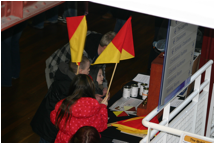
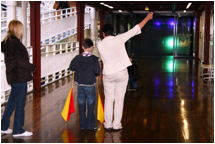
Signalling by semaphore Learn how messages were sent before the invention of electricity. Have a go yourself at sending messages by waving signal flags and see how easy or hard it is! |
|
Tin cans and string It's true, two tin cans connected by a piece of string really makes a communications system. Don't believe us, or want to find out how, then come along and have a go for yourself! |
|
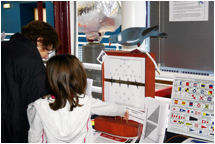
Needle Telegraph The communications revolution really took off once electricity was harnessed to send our messages. Charles Wheatstone and William Cooke were the first to demonstrate an electric telegraph. Come along and try sending a message using one of their needle telegraphs. But you'll have to send your message using only 20 letters. |
|
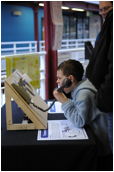
Morse code It was the Morse telegraph that became the world's first global network – the Victorian Internet as it is now known. Within our exhibition we have constructed a fully working Morse telegraph using original equipment that is over 100 years old. You may have seen it in the cowboy films, now come along and have a go yourself. Learn how messages are sent using a sequence of dots and dashes. |
|
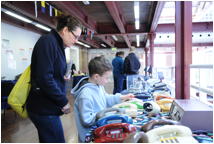
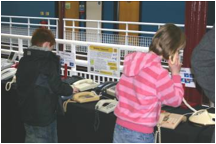
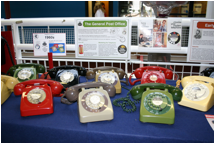
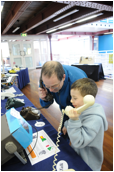
Telephones galore One of the most popular parts of our exhibition is our telephone timeline showing how the humble telephone has evolved from a wooden box to a multi-function communications device. Enjoy looking for your first phone and reminiscing about a time when telephones had rotary dials instead of push button keypads. Maybe you have never used a rotary dial, maybe you just want to do it again. Several of these telephones are also wired up so that you can call one to another and learn a little more about how the telephone works. There's also a section devoted to novelty phones featuring the dog phone, a piano, a frog and even an animated Homer Simpson. |
|
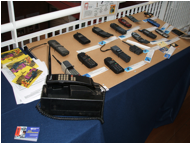
Mobile phones The mobile phone was introduced into the UK in 1985 but it looked quite different then. See how it has evolved and find out why and how it has shrunk to something which now fits comfortably into your pocket or bag. Do you know how many text messages are sent in the UK each day? |
|
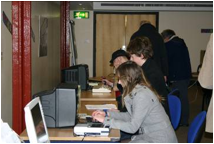
The Home Computer There was a time when people didn't have computers in their homes but this changed dramatically in the 1980s. Do you remember the Sinclair Spectrum, BBC Micro or PET? Can you imagine loading programs using cassette tapes and a time when 64K of memory was cutting edge technology? We have several working examples of these machines in the exhibition for you to use and experience those early days of the home computer. Remember that had it not been for the home computer we may well never have connected them to the telephone network and the Internet may not have grown into the global phenomena of today.
|
|
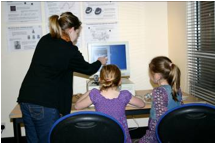
The Internet The Internet dates his history back to 1969 but it was the invention of the world-wide-web in 1989 that truly fuelled its expansion. Do you know how the Internet works?
|
|
Fibre Optics Today's communications networks transmit information using light passing through fibre optics. Find out how your voice can be converted into light. |
|
Seeing your voice You may have talked on the telephone but have you ever seen your voice? How exactly does the telephone convert your voice into electricity? With this demonstration you'll find out how and see your voice pattern on an oscilloscope. |
|
Follow our telecommunications trail and learn how our ability to communicate has advanced. Talk to engineers about the future of telecommunications. Most of all - come along and have fun! We are delighted that our exhibitions are supported by the BCS, BT Connected Earth and the itp. We also regularly feature contributions and demonstrations from industry.
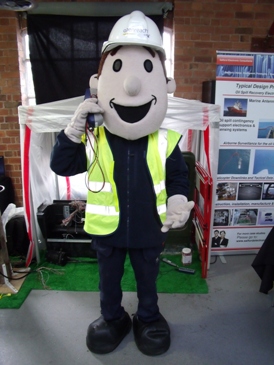
. . . . and you might even get to say hello to Ollie Openreach . . . .
|
|
|
Dates for your diary Our next exhibition is scheduled for: Saturday 25th and Sunday 26th October 2014 at the University of Salford,
MediaCity campus 10:00am to 4:00pm both days, free entry. |